
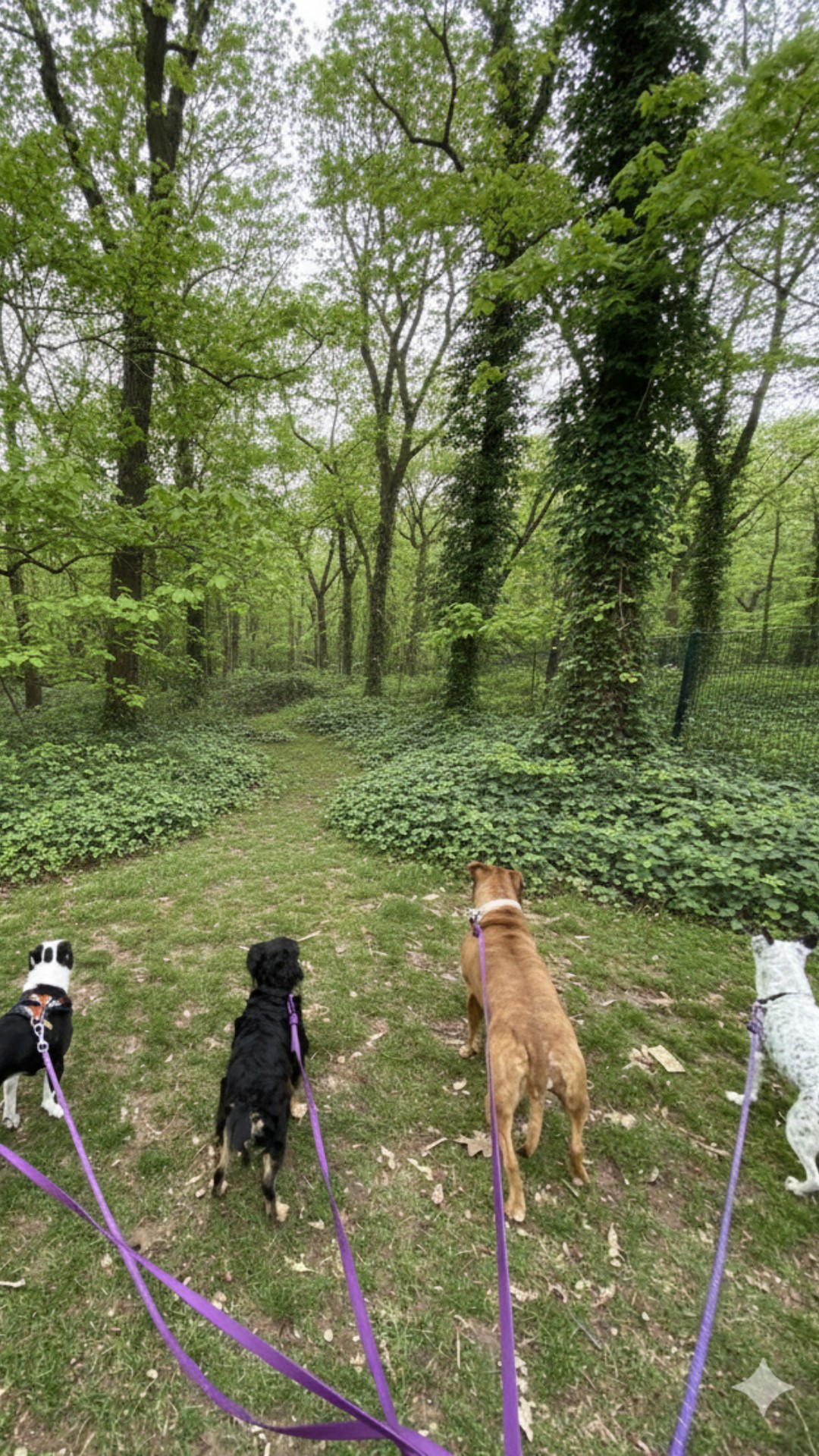
Your dog doesn’t need another walker — they need a mission.
A quick loop around the block doesn’t give a dog the work they’re built for.
If that makes sense to you, then we’re already aligned.
What This Is
Dog Missions are 90–120+ minute, purpose-driven excursions through Prospect Park’s interior trails.
Not walks. Not daycare. Not “exercise.”
They are structured work guided by one Pack Ranger and supported by a small, stable group.
Since 2018, I’ve led missions for dogs in Park Slope, Prospect Heights, Gowanus, Carroll Gardens, and Boerum Hill.
One Ranger. One rhythm. One consistent relationship.
What changes for dogs:
Calmer behavior, smoother recovery after stimulation, better rest, clearer focus, and a quieter nervous system.
Parents describe it the same way:
“It’s like someone turned the volume down inside their head.”
Who thrives: energetic dogs, overstimulated dogs, shy dogs, dogs who benefit from routine and challenge.
Not ideal: medically restricted dogs, dogs unsafe in a group, very young puppies.
If you’re unsure where your dog fits:
Text MISSION to 718-502-7878.
You’ll get a direct, honest read.
Why This Exists
Most dog parents handle mornings and evenings themselves.
It’s the long, unstructured afternoon stretch where things fall apart.
A standard walk doesn’t give dogs purpose, belonging, or meaningful work — and it doesn’t relieve the pressure parents feel to “make up for it” before and after work.
A mission solves both problems:
- the dog gets real work,
- the parent gets a simpler routine,
- and the entire day becomes easier for everyone.
City Dogs Live in a Constant State of “Almost Enough”
After thousands of hours guiding dogs through Prospect Park, the same pattern shows up again and again:
City dogs get stimulation — but not the kind of work that organizes their mind or steadies their body.
Their days often look like:
- short, repetitive neighborhood walks
- noise and unpredictable stimuli
- rotating handlers with rotating expectations
- minimal physical variation
- no consistent group
- no clear role
This doesn’t create “bad behavior.”
It creates uncertainty — which turns into restlessness, scavenging, pulling, reactivity, pacing, and difficulty settling at home.
These aren’t personality flaws.
They’re the signs of a dog who hasn’t had a real job in a long time.
Why Walks Don’t Give Dogs What They Need
Walks are necessary for hygiene and routine.
But they don’t meet the deeper needs of a working, social animal.
Walks usually offer:
- flat ground
- stop-and-go pacing
- constant distractions
- minimal challenge
- little engagement
- no meaningful job
- no stable group
A walk fills time.
A mission gives direction.
Curious what a more balanced dog might bring home?
Text “MISSION” to 718-502-7878.
What a Mission Actually Is
A Dog Mission is a 90–120+ minute purposeful excursion through Prospect Park’s real terrain — not the paved loops, but the interior trails that demand awareness and coordination.
It’s structured work built around:
- a clear route
- a stable pack
- one consistent leader (me)
- purposeful thresholds and challenges
- terrain that requires attention
- a rhythm that organizes the nervous system
This gives dogs what city routines cannot:
purpose, belonging, and structure.
Where I Operate & How Missions Run
I serve Park Slope, Prospect Heights, Gowanus, Carroll Gardens, and Boerum Hill — neighborhoods that let me keep a reliable rhythm, walk pickups, and stay connected to the dogs’ daily environment.
I lead two missions a day:
- late-morning (around 11am–2pm)
- afternoon (around 2–5pm or 3–6pm)
On days when both groups are small, I merge them into one longer mission.
Those days take us deeper into the park, across more terrain, and new bonds form between dogs who rarely share the trail.
I prefer to walk the pickup rather than transport dogs.
It builds anticipation, momentum, and the small celebration that happens every time a new pack member joins the flow.
It also means pickup and drop-off happen within a range, not a specific minute.
Dogs don’t live on strict schedules — and missions work because we follow their pace, not the clock.

Purpose Changes Everything
Every mission gives dogs a job — something their body and mind instantly understand:
- follow
- coordinate
- move with the group
- navigate terrain
- overcome hesitation
- stay on task
Purpose organizes attention and settles scattered energy.
A dog with a job doesn’t chase stimulation — they drop into a grounded working state because the mission finally makes sense to them.
The Pack Does the Real Teaching
The biggest transformations don’t come from commands.
They come from being part of a small, consistent group.
Within the pack:
- shy dogs borrow confidence
- sensitive dogs settle
- high-energy dogs regulate
- older dogs re-engage
- young dogs learn by watching
- impulsive dogs stop guessing
- anxious dogs follow the group’s movement
Belonging stabilizes dogs more than anything else.
PACK STORY — MASHA (placeholder)
A brief real-example snippet demonstrating confidence gained or hesitation reduced.
The Wag Damage — What Inconsistency Costs
Modern dog care often means:
- a different walker each day
- shifting expectations
- unpredictable timing and routes
- new energy entering their world
Even when each walker is skilled, the system creates instability.
I call this The Wag Damage — the slow decline caused by fragmented care.
A mission reverses this with:
- one Pack Ranger
- one group
- one rhythm
- predictable relationship dynamics
Consistency builds trust.
Trust creates stability.
Stability changes everything else.
Why Prospect Park Works
Sidewalks can’t give dogs what Prospect Park does.
The interior offers:
- climbs and descents
- narrow passes
- uneven natural surfaces
- scent-rich corridors
- water, mud, roots, stone
- long uninterrupted stretches
These teach:
- balance
- coordination
- pacing
- spatial awareness
- problem-solving
When the environment participates, dogs don’t “exercise.”
They engage.
What Changes for a Dog Over Time
With consistent missions, dogs become:
- calmer
- more resilient
- more confident
- more coordinated
- better at resting
- less reactive
- more present at home
Parents describe the shift the same way:
“It’s like someone turned the volume down inside their head.”
That’s not exhaustion.
That’s regulation — a nervous system finally moving in a steady rhythm.
Who This Is For (and Not For)
A good fit:
- dogs who need direction
- overstimulated dogs
- energetic dogs who need structured work
- shy or sensitive dogs
- dogs who thrive on routine
- dogs who love exploration
- adult dogs in normal health
Not ideal:
- medically restricted dogs
- dogs unsafe in a group
- very young puppies
If your dog isn’t a fit, I’ll tell you directly.
If you want clarity on whether missions are right for your dog,
text “MISSION” to 718-502-7878.
Start With the Truth
Many people look for a dog walker.
But what most dogs actually need is something deeper.
A dog doesn’t need another walk.
They need purpose, belonging, and structure.
A mission gives them all three —
and gives you a dog who moves through life with clarity and steadiness.
If you want to know whether this is right for your dog,
text MISSION to 718-502-7878.
You’ll get a straight, honest answer.